

October 7, 2026
Where Are Armenia–China Relations Headed? The Historical Imperative to Rethink Them
As China’s role in the international system continues to expand, Armenia faces a growing need to reassess the place of China in its long-term foreign and economic policy. More than three decades after the establishment of diplomatic relations, Armenia–China ties have reached the level of a strategic partnership, yet their economic potential remains largely unrealized.
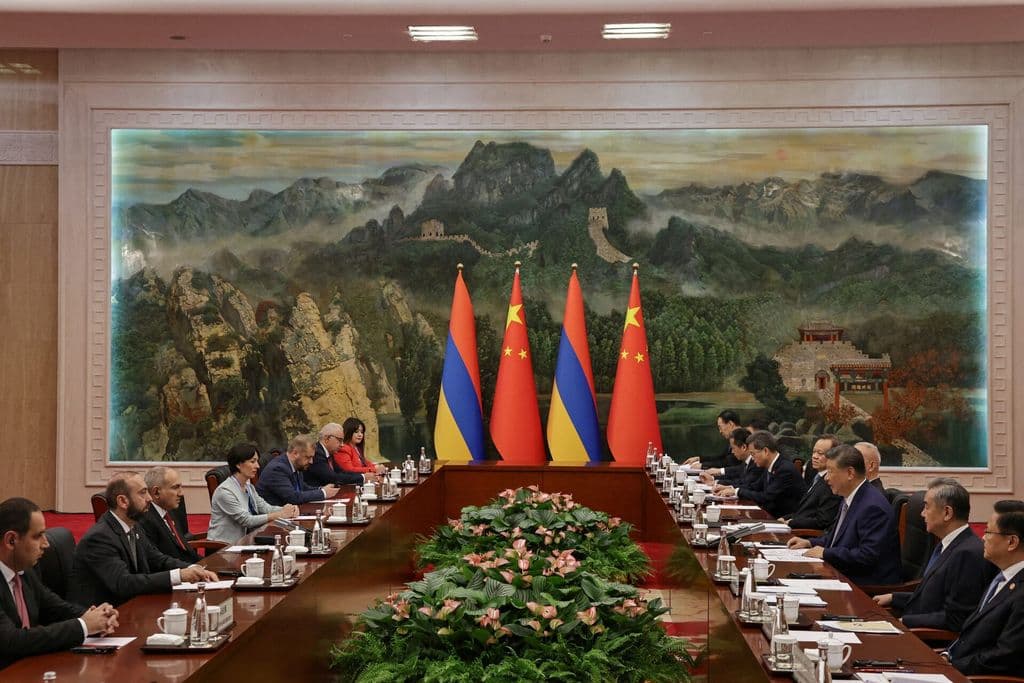
On September 23, 2026, Chinese President Xi Jinping made an official visit to Washington, D.C. The visit was marked by a unique feature: President Trump personally greeted President Xi at the airport. This was one of the few occasions in U.S. history when a president personally greeted a foreign leader at an airport during an official visit. The first such occasion was in 1939, when Franklin Roosevelt greeted King George VI of Great Britain at Union Station, and the second was in 1959, when President Eisenhower greeted Soviet leader Nikita Khrushchev at Andrews Air Force Base. In 1939 and 1959 respectively, Great Britain and the Soviet Union were superpowers.
The American and Chinese press have already noted the uniqueness of Trump's gesture in the US diplomatic protocol . Whether a symbolic demonstration of the utmost respect or an emphasis on the strategic importance of the visit, this step best illustrates the changing picture of the world. At the end of the 20th century, the world went from bipolar to unipolar, and now it is again close to making a transition from unipolar to bipolar. The technological divide of the world has effectively divided into two poles, the United States and China. And although in May of this year in Beijing, Donald Trump and Xi Jinping described the relations between the two countries as a "constructive relationship of strategic stability", fierce competition is taking place between the two countries in almost every field, from artificial intelligence and space exploration to medical technology. And the economies of the two countries together account for almost half of the global economy.
The second geopolitical pole which counterbalances the US has actually already been established, but de jure it has not yet been enshrined in the reality of establishing the world order. In this process of a changing world, it is a historical imperative for Armenia to rethink Armenian-Chinese relations.
When Armenia and China established diplomatic relations in April 1992, the two countries were in a similar situation: two old nations rethinking their roles in a new world. Armenia had just gained independence from the USSR and realized the millennial dream of the Armenian people to have their own statehood, while China, after two centuries of extreme hardship, had embarked on the path of economic reform, opening up to the world, and peaceful development. In the early 1990s, Armenia and China were united by one common characteristic: two newly developing states, each with a faith and an optimistic vision of the future.
Relationship trajectory
During the presidency of Levon Ter-Petrosyan, the first visit of the President of the Republic of Armenia to Beijing took place in May 1996 and meetings were held with the General Secretary of the Central Committee of the Communist Party of the PRC Jiang Zemin, as well as Prime Minister Li Peng, as a result of which a joint communiqué on the foundations of friendly relations was signed, which enshrined the principles of sovereignty, non-interference and mutually beneficial cooperation. It envisaged the development of ties between enterprises and banks, as well as cooperation in the fields of industry, science, culture and transport. Permanent diplomatic relations were established and the legal basis for cooperation was laid.
Under Robert Kocharyan, Armenian-Chinese relations acquired a more pronounced economic orientation. The diplomatic foundation laid under Ter-Petrosyan began to be supplemented by industrial projects and the expansion of political ties. The main political result can be considered the joint statement of the presidents of the two countries on September 27, 2004. It clearly defined trade and economic cooperation as the main direction of future cooperation. President Kocharyan emphasized energy, the chemical industry, agriculture and science. Hu Jintao supported the policy of expanding Chinese investments in Armenia and the participation of Chinese companies in Armenian infrastructure projects. Armenia reaffirmed its commitment to the “One China” principle.
During Serzh Sargsyan’s presidency, Armenian-Chinese cooperation expanded to include industry, finance, infrastructure, and education. The main diplomatic event was President Sargsyan’s state visit to China in March 2015, which expanded the contractual framework of cooperation. Documents on cooperation in the creation of the “Silk Road Economic Belt” were signed.
The 2018 Velvet Revolution in Armenia raised some concerns in the international arena about the continuity of the country’s foreign policy, but in May 2019, Nikol Pashinyan’s visit to Beijing reaffirmed the friendly and cooperative relations between Armenia and China. On August 31, 2025, as a result of negotiations between President Xi Jinping and Prime Minister Pashinyan, Armenian-Chinese relations were upgraded to strategic partnership. The two sides have announced plans to deepen cooperation within the framework of the Belt and Road Initiative, and China has supported Armenia’s efforts to raise its legal status in the Shanghai Cooperation Organization.
Modern challenges and realities
April 2027 will mark the 35th anniversary of the establishment of Armenian-Chinese diplomatic relations. Of course, the two countries look completely different today than they did in the early 1990s, when they were both on the path of development. Despite economic development, Armenia still has almost the same geopolitical weight as it did 35 years ago. China, in turn, has transformed from a developing country into a global superpower capable of challenging the West.
Today global geopolitical realities are also completely different from the last decade of the 20th century. After the normalization of Sino-American relations in the 1970s, there was a belief in broad political and academic circles in Washington that China's economic development would also lead to the liberalization of the political system. And China, following the example of Japan, South Korea and Singapore, would become part of the liberal world led by the United States. However, since the 2010s, the US political elite has finally become convinced that China does not intend to change its political structure of governance, and that "socialism with Chinese characteristics" can work even more effectively than classical liberal democracy. American political scientist Francis Fukuyama, who in the 1990s declared the "end of history" and the absolute victory of the liberal democratic system, was forced to admit the effectiveness of the Chinese government system, which is able to quickly make complex decisions and implement them.
Thus, the Armenian authorities, when building the country's medium- and long-term policy, must take into account security challenges and deepening Sino-American contradictions.
Over the past three decades relations between Armenia and China have developed steadily, reaching the status of a strategic partnership. Unlike other countries that have developed mainly economic relations with China, Armenia’s relations with China have developed mainly in the political, cultural and educational spheres. Unfortunately, no significant economic or investment projects have been implemented yet. This is best reflected in China’s investments in the countries of the region. According to the Eurasian Development Bank , as of the first half of 2025, Chinese direct investments in Azerbaijan amounted to 405 million US dollars, and in Georgia - 280 million dollars. In Armenia, they amounted to only 5 million dollars.
Armenia having the status of a strategic partner of China and being a country of the “Belt and Road” initiative, could attract Chinese best practices for infrastructure development. In this field, China is one of the world leaders, and Armenia should focus on the issue of attracting large Chinese companies to Armenia. For example, the two largest construction companies in the world, China State Construction Engineering Corporation (CSCEC) and China Railway Engineering Corporation (CREC), have completed or operated overseas projects in more than 100 countries. Armenia has the opportunity to attract them for the development of the country’s roads, bridges, airports and metro infrastructure.
Another important area for deepening cooperation is the technological sector. China is also one of the leaders in the development of digital technologies. Armenia should seriously benefit from China's best practices in the digitalization of logistics and digital payment systems.
Armenia in turn should position itself for China as a hub for the Belt and Road Initiative in the South Caucasus region, thus ensuring the penetration of Chinese investment projects and technologies into the country.
In summary, Armenia as a strategic partner of China, has unique opportunities to promote the country's economic development by involving Chinese companies in the development of Armenia's infrastructure. It should also strive to play a greater role in the development of the Belt and Road Initiative in the South Caucasus, as well as expand its involvement within the Shanghai Cooperation Organization.
Armenia must rethink its relations with China in all areas, as China is no longer the country with which Yerevan established diplomatic relations 35 years ago. Today Armenia is dealing with the second global pole in the person of China. Yerevan must correctly assess all long-term geopolitical challenges and choose a path towards development, rethinking and correctly building its relations with China.
Originally published: Panorama.am, 24 September 2026
Author: Vahan Grigoryan
Topics: Armenia–China Relations · China · Foreign Policy · Belt and Road Initiative